

In micro-cap investing, the exciting story usually starts with growth. The painful story often starts with the balance sheet.
Most investors notice the headline first. A new product launch. An earnings beat. A new contract. A strategic acquisition. A sudden move in the stock price.
Those developments matter. They can bring overdue attention to an overlooked company. But before any growth story can reward shareholders, the company has to stay in the game long enough for that growth to take hold.
That is why a company’s balance sheet is one of the first places we turn when analyzing micro-cap stocks. In a large company, a weak balance sheet may be a manageable problem. In a small company, it can quickly torpedo the entire growth narrative.
The balance sheet is not just an accounting statement. In micro-caps, it can be the difference between a company that has time to build value and one that is forced to raise money before the story has a chance to work.
Cheap to book value is a clue, not a conclusion
A stock trading below book value can look cheap. Sometimes it is. Sometimes the market is telling investors that the assets are not worth what the balance sheet says they are.
That is why book value is useful, but only as a starting point.
At The Bowser Report, we consider book value when rating a micro-cap stock. Book value measures the difference between a company’s assets and liabilities, divided among shareholders. When a stock trades below book value, investors may have the opportunity to buy the company at a discount to its stated net asset base.
However, a bargain is not guaranteed.
Investors must look at the assets behind the book value. Hard assets such as cash, investments, and real estate may offer more immediate value, while softer assets like goodwill are less tangible. That is why book value is more useful when investors also consider how much of that value is tangible and how reliable the asset base appears to be.
It is also worth comparing a company’s book value to peers within its industry. Some industries naturally trade at higher or lower price-to-book multiples, so an apparent discount may look different once it is viewed in the proper context.
Book value can help anchor the downside. But only after investors inspect what that book value is actually made of.
Liquidity is boring until it disappears
With small stocks, there is a lot of unknown. Liquidity is the cushion that helps a company absorb the unexpected.
When rating stocks, we consider a company’s current assets relative to its liabilities. The higher that ratio, the more immediate flexibility the company has.
That flexibility matters. A customer may delay payment. Inventory may need to be pre-built. A weak quarter may pressure earnings. A new product may take longer than expected to gain traction.
A company with strong liquidity can often absorb those setbacks. A company without it may be forced into a financing deal at the worst possible time.
That is when a temporary business challenge can become a permanent shareholder problem.
For micro-caps, liquidity is not just a comfort metric. It is operating oxygen. It gives management time to solve problems, continue investing, and wait for the business to develop without immediately turning to outside capital.
Debt can turn growth into damage
Debt is not always bad. At times, it may be necessary to fund growth, complete an acquisition, or bridge a temporary business need.
But debt can become restrictive quickly, especially for smaller companies. Borrowing costs remain elevated, refinancing options are not always available, and lenders may offer less flexibility to companies with limited scale.
That is why no long-term debt is ideal in the Bowser Rating System. When debt is present, we want it to be manageable, preferably below 10% of annualized sales.
The goal is simple. A micro-cap should not need a good quarter just to repair the past. It should be able to use that good quarter to build the future.
Little or no long-term debt prevents a company from getting dragged down by its obligations. It reduces the drag of interest expense, lowers refinancing risk, and helps ensure that future growth benefits shareholders instead of being consumed by principal and interest.
This matters because debt can quietly change the investment story. What starts as a growth opportunity can become a balance sheet repair project. Instead of funding expansion, cash flow goes toward obligations.
That is not the kind of growth we want to invest in.
This is one reason we look at balance sheet strength as part of a broader process, not as a standalone metric. You can see how these factors fit into our full micro-cap investing framework here.
Financial strength can fund the next chapter
The balance sheet is not only defensive.
A strong balance sheet does more than help micro-caps avoid failure. It can actively support value creation.
Financial strength can help fund inventory for expansion, increase sales capacity, support product development, make strategic acquisitions, buy back shares, pay dividends, or simply allow management to wait for better market conditions before raising capital.
That last point is especially important.
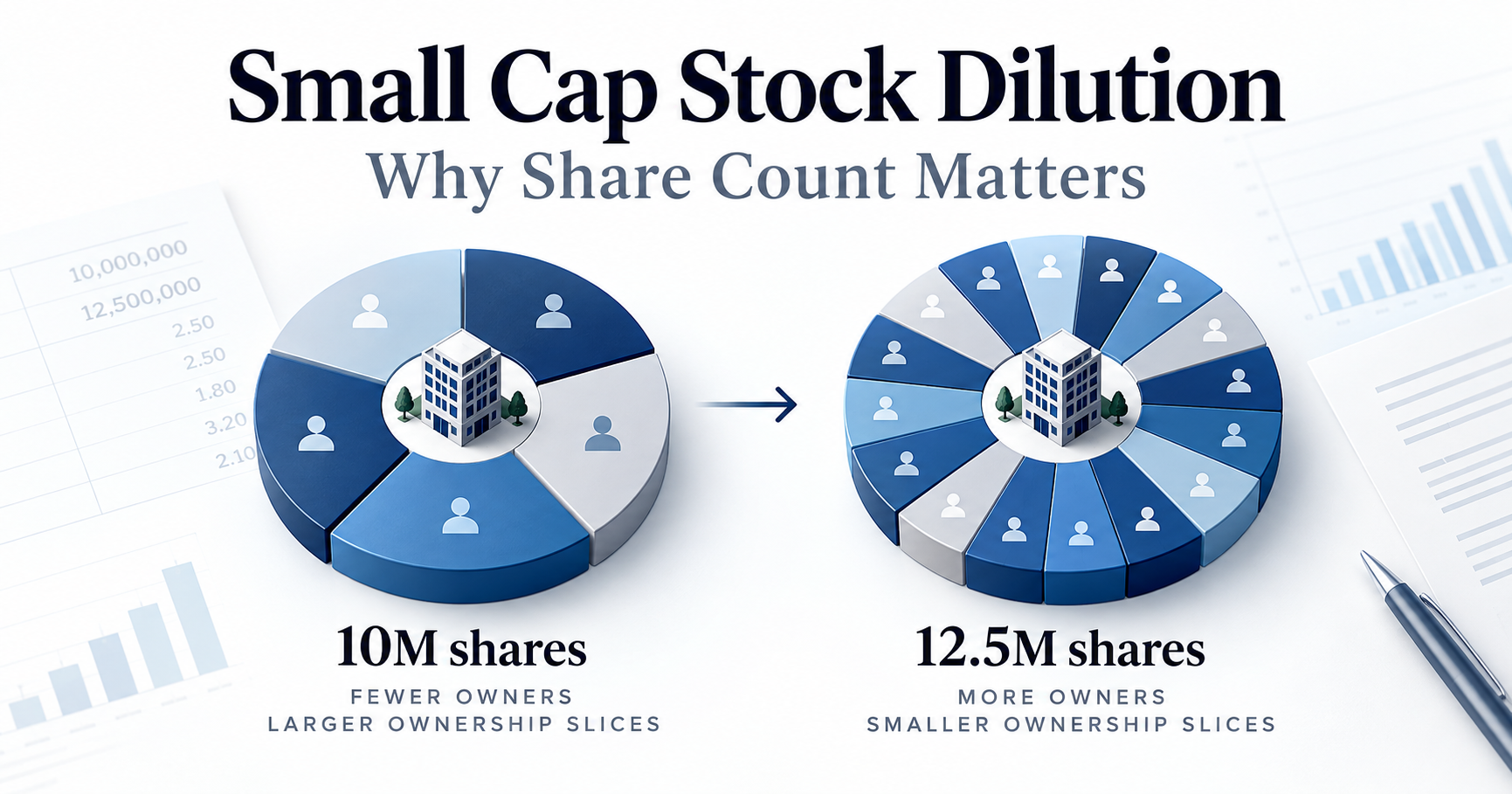
A weak balance sheet can force a company to raise money when its stock price is low. Each time a company issues shares or takes on debt, existing shareholders give up a piece of the future, either through dilution or through cash flow that must be redirected to principal and interest.
A strong balance sheet gives a micro-cap more ways to pursue growth without constantly returning to shareholders or lenders for support. Over time, that flexibility can compound the benefits of growth.
This is where balance sheet strength becomes more than protection. It becomes opportunity.
Foundation first, story second
Each of these factors plays off the others.
Book value above market value can indicate overlooked asset value. Strong current assets relative to liabilities suggest financial flexibility. Little or no long-term debt shows the company is not weighed down by past financing decisions.
Together, those factors help answer a critical question: does this company have the financial foundation to survive long enough for the investment thesis to work?
Still, none of these factors should be viewed in isolation. A strong balance sheet is most powerful when paired with improving operations, insider alignment, and management that can turn financial strength into shareholder value.
That is the broader point behind the Bowser process. We are not looking for strong balance sheets just for the sake of safety. We are looking for companies with enough financial strength to give the rest of the thesis time to matter.
The balance sheet is the foundation. But a structure must still be built on top of it.
Balance sheets drive value creation
Balance sheets are rarely the exciting part of a micro-cap story. They do not make headlines like a new contract win, a strategic acquisition, or a sharp increase in earnings.
But they often determine whether those developments can actually create lasting shareholder value.
In small companies, financial flexibility matters. Book value can help anchor the downside. Strong liquidity can keep the business moving through uneven periods. Little or no long-term debt can allow future growth to benefit shareholders instead of being consumed by principal, interest, or dilution.
That is why the Bowser Rating System places real weight on the balance sheet.
A strong balance sheet does not complete the investment case by itself. But it gives the company room to survive, adapt, and grow long enough for the rest of the thesis to matter.
Before asking how much a micro-cap can grow, investors should first ask whether the company has the financial strength to survive long enough for that growth to matter.
Want to see how balance sheet strength fits into a disciplined micro-cap investing process?
Start with our overview of the Bowser approach to learn how we evaluate low-priced stocks using financial strength, operating improvement, valuation, and insider alignment.
Or, if you want to see the process applied to real stock recommendations, request a free sample issue of The Bowser Report.




Leave A Comment