

As a new year unfolds, certain themes often begin to surface in small-cap stocks. While no single month determines outcomes, early themes can sometimes reveal which companies are strengthening their fundamentals beneath the surface before the market takes notice.
Rather than focusing on individual stock picks or short-term predictions, this is a useful time to step back and assess which setups are beginning to take shape. The goal is preparation—improving probabilities through a disciplined, repeatable process.
The Bowser Rating System as the Foundation
The Bowser Rating System serves as the foundation for all of our analysis. At its core, the system emphasizes fundamentals over narratives, filtering a broad universe of small-cap stocks into a manageable group of higher-probability candidates.
By applying a consistent 13-point framework, the system narrows the focus to companies that meet defined financial, balance sheet, and operating criteria. This structure reduces noise and helps keep decision-making grounded in fundamentals rather than market sentiment.
Theme #1: Margin Expansion as an Early Signal
As observed throughout 2025, margin expansion has become an increasingly important indicator of potential value creation in an environment where borrowing costs remain elevated and demand conditions can be uneven.
True margin expansion requires investors to:
- Distinguish between sustainable cost discipline and one-time cost reductions
- Look for improvement over multiple periods rather than isolated quarters
When margins expand in a durable way, operating leverage improves and more cash flows to the bottom line. That cash can then be reinvested into capacity, marketing, dividends, share repurchases, or other efforts aligned with shareholder value creation.
Theme #2: Insider Buying as Confirmation, Not a Trigger
When margin trends are improving and the underlying business is financially sound, insider buying can serve as a useful secondary signal.
Within a disciplined framework, insider activity is most meaningful when:
- Insider ownership is already relatively high
- Purchases occur in the open market
- Dilution remains limited or absent
Not all insider buying carries the same weight. Small, one-time purchases or buying that coincides with dilution often provide little insight. In contrast, larger purchases and consistent accumulation over time can act as confirmation that management views the company’s prospects favorably.
Theme #3: Strong Balance Sheets in a Still-Selective Environment
Balance sheet strength is a central pillar of the Bowser Rating System. Companies that generate cash, limit leverage, and retain the ability to self-fund growth are better positioned to navigate uncertain environments.
Strong balance sheets help limit downside risk while preserving flexibility. Over time, that flexibility can support sustainable growth as operating conditions improve and opportunities emerge.
How These Signals Work Together
Margin expansion, insider alignment, and balance sheet strength do not signal higher-probability setups on their own. The highest-conviction opportunities tend to emerge when multiple signals align within a consistent framework.
Even then, as recent trends have evolved to show, overlapping signals improve probabilities, not certainty. The objective is not prediction, but stacking favorable conditions in a disciplined way.
These themes build directly on what January revealed about small-cap fundamentals, where early margin, insider, and balance sheet signals began to surface.
See How We Apply This Framework
Get a Free Sample Issue of The Bowser Report to see how margin expansion, insider alignment, and balance sheet strength are evaluated in real coverage.
What We Are Not Doing
A rules-based process also defines what to avoid. We are not:
- Chasing momentum
- Reacting to headlines
- Expecting immediate results
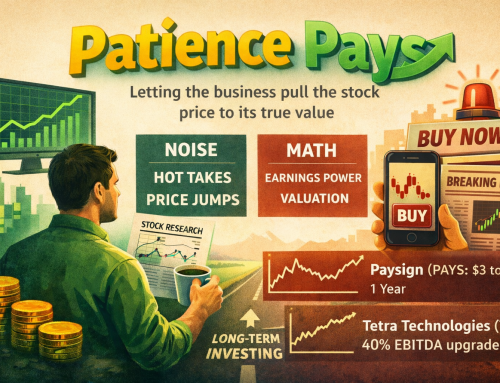
Each of these behaviors increases risk by shifting focus away from fundamentals and toward short-term market noise, leading to FOMO. Discipline, not reaction, is what sustains long-term results.
What This Means for Positioning
Long-term investing rewards patience. Setups often take time to develop, and progress is rarely linear.
Investors benefit from tracking high-probability signals over time and clearly documenting why a position was initiated. Any tracking process should identify:
- The fundamental rationale for entry
- The primary signal driving the decision
- The conditions that would invalidate the thesis
This approach emphasizes preparation over timing and process over emotion.
Conclusion: Process Over Prediction
The Bowser philosophy is rooted in fundamental analysis and consistency. Long-term success comes from applying the same filters repeatedly, while allowing emphasis to shift within the same framework as market conditions evolve.
In small-cap investing, opportunity most often emerges not from urgency or prediction, but from discipline applied over time.
Apply a Disciplined Small-Cap Process
The Bowser Rating System is built to filter noise and focus on higher-probability setups.
Get a Free Sample Issue to see how the framework works in practice.






Leave A Comment