

Most investors look at a list of current prices, count how many stocks are up and how many are down, and then decide whether a strategy works. In small-cap investing, that approach is far too simplistic.
The Bowser Historical Review is a good example. Most picks are currently below their original recommendation price, yet many rallied substantially after recommendation before eventually falling back, being acquired, merging, or otherwise ceasing to trade.
That is why investors need to evaluate performance in light of the strategy being applied, not just by looking at a snapshot in time. That is the real value of the Historical Review.
What the Historical Review actually shows
The Historical Review shows how returns are actually produced in the Bowser process.
This is not a system built around a smooth stream of small wins. It is built around volatility, imperfect current-price outcomes, and a smaller group of outsized winners that drive a disproportionate share of long-term gains.
While many picks are currently below their original recommendation price, only 7% did not gain anything after recommendation, while 66% doubled or more. That is why the Historical Review is best understood through the Bowser process rather than through a simple up-or-down snapshot.
At the same time, a smaller group of exceptional winners produced an outsized share of the newsletter’s long-term results: 14% gained 1,000% or more. They are not the majority of recommendations, but they are a major reason the process works over time.
Long-term results in low-priced stocks are not built on a perfect win rate. They are built on a disciplined framework that captures upside, limits downside, and keeps investors exposed to the exceptional winners when they emerge.
Why patience is necessary
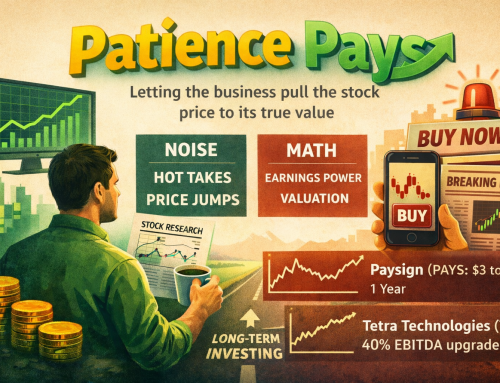
The number one takeaway from the Historical Review is patience. When paired together, the Bowser Game Plan and newsletter recommendations are designed to work over time, not overnight.
Many of the biggest winners took time to separate themselves. In many cases, the market needed multiple quarters of consistent execution before rewarding early shareholders.
That is why judging the process too early can be so costly. Investors who abandon a sound strategy prematurely often do so before the payoff distribution has had time to work in their favor. As long as a company remains structurally sound and the risk-to-reward profile remains attractive, reacting too quickly to price volatility can lead to emotional decisions rather than disciplined ones.
A key point to remember is that short-term volatility and long-term progress can coexist. A stock’s price may swing sharply in the near term while the underlying business continues to execute quarter after quarter and year after year.
Why diversification is not optional
The Game Plan calls for a portfolio of 12 to 18 stocks for a reason. Diversification is not a side note to the Bowser process. It is essential to it.
The Historical Review shows that long-term gains are driven disproportionately by a relatively small group of exceptional winners. Because of that, it is unrealistic to expect that investors will consistently identify those biggest winners in advance.
Diversification is what gives a portfolio repeated exposure to the stocks that go on to outperform. The more disciplined and diversified the portfolio, the better the odds of capturing one or more of the names that drive outsized long-term returns.
On the other hand, failing to diversify increases the chances of missing the relatively small number of stocks that make the biggest difference over time.
Why selling rules matter
With many picks currently below their original recommendation price, it is critical that investors understand when to exit positions in order to maximize gains and limit losses. The Bowser process is not designed around buying and holding forever.
The rules are clear:
- Sell half when a stock doubles.
- Sell the remainder after a 25% drop from the most recent high.
- Sell all shares if the stock falls 50% without first doubling.
The Historical Review reinforces those rules because many weaker long-term outcomes still included meaningful rallies along the way. The process is not simply about identifying winners. It is about having rules that help investors capture upside when it appears and cut underperformers before they drag down overall portfolio returns.
Just as importantly, the Selling Plan allows true winners to keep running while still protecting gains. That balance is what makes the process practical in a volatile part of the market.
The Historical Review is a behavior lesson, not just a scorecard
Volatility is a natural characteristic of small-cap stocks. That creates risk, but it also creates opportunity.
The Historical Review is valuable because it reminds investors how to operate within that environment. Even when the underlying companies are strong, patience, diversification, and a rules-based selling strategy still matter. That combination helps protect against substantial losses while making room for exceptional gains.
The lesson is straightforward: stay diversified, stay patient, and follow the Selling Plan. Investors should not mistake an uneven path for a broken process.







Leave A Comment